
 CZ
CZ EN
EN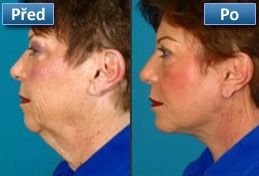
The principle of the procedure is the removal of excess skin from the temporal region, cheeks, and neck. A facelift can be combined with other procedures that enhance facial expression, such as eyelid or forehead surgery.
Are you a suitable candidate for a facelift?
Indications for surgery include more pronounced skin laxity in the lower half of the face and the neck, manifested for example by:
- pronounced nasolabial folds (running from the sides of the nose to the corners of the mouth)
- sagging cheeks caused by weakening of the muscles in the lower half of the face
- so-called “double chin” in otherwise slim individuals, caused by loose skin and excess fat under the chin
Facelifts are performed on both women and men. The main requirement is good overall health. Most patients are between 40 and 60 years of age. Naturally, younger individuals whose skin shows signs of aging earlier can also undergo the procedure, as can older patients if their health condition allows it. Absolute certainty as to whether a facelift is suitable for you can be obtained through a consultation with one of our plastic surgeons. It is equally important to discuss your expectations with them. Do not hesitate to ask questions or share your concerns—realistic expectations are the most important prerequisite for satisfaction with the surgical outcome.
Before a facelift
If you decide to undergo a facelift after consultation with the surgeon, you will arrange dates for the preoperative examination and the surgery itself, either in person or by phone. During preparation, it is essential to follow the doctor’s instructions regarding food, fluids, smoking, and the use of certain medications. We also recommend arranging accompaniment and transportation home after discharge into home care.
The procedure itself
The operation is performed under general anesthesia and lasts 90–120 minutes.The surgeon makes an incision starting in the hair-bearing temple area just in front of the ear, curves around the earlobe, continues behind the ear, and at approximately two-thirds of the ear height extends into the hairline at the nape of the neck. The skin of the temples, cheeks, and neck is released from the underlying tissue, and the measured excess skin is removed. At this stage, subcutaneous fat may also be removed. For a longer-lasting facelift effect, the underlying fibromuscular structures (the so-called SMAS lift) are tightened in a similar manner. Very often, this classic procedure is complemented by vibration-assisted tumescent liposuction of the neck and submental area, and especially by correction of the central third of the neck (the so-called neck lift). During this step, the surgeon treats the muscle tissue in the area to achieve tightening. The final result is restoration of the natural angle and contour between the chin and the front of the neck. Incisions are usually closed with intradermal absorbable sutures. To drain fluid that accumulates under the skin after surgery, drains are inserted between the skin and the muscle. To reduce swelling and bruising, an elastic head bandage is applied after the operation.
After the facelift
Drains are usually removed on the second day after surgery, when the patient is typically discharged into home care. The head bandage is changed during follow-up visits and is definitively removed 10–14 days after surgery. It is always necessary to follow the instructions of the attending physician, who will explain everything in detail during a personal consultation. The period of surgical recovery is approximately 2 weeks. However, full physical activity with all associated risks is recommended only after one month.
Facial surgery should not cause serious complications. Your surgeon will recommend medication to manage any postoperative pain. Swelling of the face occurs after surgery, reaching its peak around the 3rd to 4th day; bruising may also appear. Partial numbness of the skin is also common and gradually resolves over weeks to months. However, in the case of severe persistent pain or significant facial swelling, do not hesitate to contact your doctor.
When will the results of a facelift be visible?
Patience is essential during the postoperative period. The final result of the operation cannot be expected within a few days or weeks. It may take several months for swelling to fully subside and for scars to stabilize. After complete healing, however, you do not need to worry about visible scars—they naturally follow the hairline and the folds around the ear and are therefore not noticeable at first glance. The effect of the procedure lasts five to ten years, depending on the individual properties of your skin. The procedure can be repeated if desired.
